
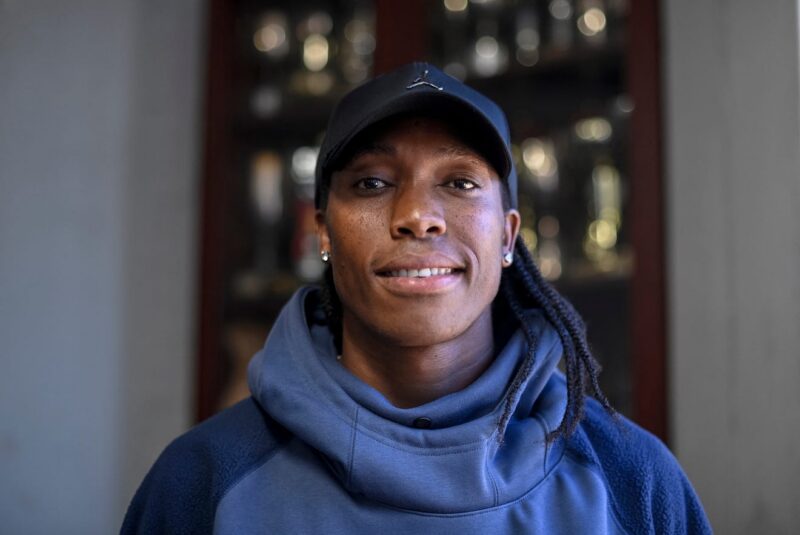
Olympic champion runner Caster Semenya expressed her disappointment Sunday with the International Olympic Committee and called out IOC president Kirsty Coventry following the IOC’s recent decision to ban transgender athletes from competing in the Games.
The decision also restricts female athletes such as Semenya with medical conditions known as differences in sex development, or DSD.
Semenya, of South Africa, said after a women’s race promoted to celebrate female strength, unity and community support that she expected more from Coventry, a native of Zimbabwe.
“Personally, for her as a leader, she’s an African, I’m sure she understands how, you know, we as Africans, we are coming from, as a global South, you know, you cannot control genetics,” Semenya said at a March 29 news conference in Cape Town.
The IOC issued the ban on March 26, reversing its 2004 decision to allow the participation of transgender women athletes.
To date, only one openly transgender woman has competed at the Olympics, a weightlifter from New Zealand who did not make it past her opening round of competition at the Tokyo Summer Games in 2021.
“(I)f the science is clear, show us who decided and don’t dress that as a lie because it’s a lie and we know because we’ve seen it,” Semenya said. “So if we were to answer or confront Kirsty, that’s how we (are) going to respond, and we’ll respond strong as we are because it affects women.”
Semenya is a two-time Olympic gold medalist in the 800 meters. She was assigned assigned female at birth but has testosterone levels higher than the typical female range. She has been banned from competing at major international meets because of her refusal to take medication to artificially reduce her testosterone levels.
The new eligibility policy, which the IOC says “protects fairness, safety and integrity in the female category,” will begin with the Los Angeles Olympics in July 2028.