
At this rate – as has become something of a recent norm in the NFL – by the time free agency officially begins on March 11 … most of the league’s available big names may have already been scooped up, whether by agreeing to contracts before then or included in trades that can be structured, if not officially finalized, right now.
And those trade winds have blown furiously in recent days, DJ Moore, Trent McDuffie and Tytus Howard already on the move – and those swaps were engineered before the biggest blockbuster of all in 2026 (so far anyway) materialized on the night of March 6. That’s when the Baltimore Ravens agreed to acquire DE Maxx Crosby in exchange for two first-round picks, including No. 14 overall this year.
The move mutually amplifies the Ravens as a Super Bowl 61 contender and the Raiders as a rebuilding bottom-feeder. It also throws another major wrinkle into Round 1 of the 2026 NFL Draft. Here’s how Crosby’s relocation further impacts our first-round projections:
1. Las Vegas Raiders – QB Fernando Mendoza, Indiana
He didn’t work out at the scouting combine. Didn’t have to. When you’re 6-foot-5, 236 pounds, paced FBS with 41 TD passes, process like a microchip and just led your school to a magical national championship? Heck, there’s virtually nothing Mendoza can do at this point to help his football résumé – though interactions with reporters and his fellow combine attendees continued to burnish his reputation as an outstanding person and teammate. (And good news − now he doesn’t have to contend with McDuffie twice a year! Also, the Raiders’ exportation of Crosby means Mendoza will almost surely get immediate and needed offensive reinforcements.) The Jets are basically on the clock.
2. New York Jets – OLB/DE David Bailey, Texas Tech
The Stanford grad came into his own with the Big 12 champion Red Raiders in 2025, tying for first in the FBS with 14½ sacks while leading the field with a 20.2% pressure percentage and mixing in 19½ tackles for losses. Bailey is scheme diverse, which could also be a boon for a team switching to a three-man front and one that just offloaded DE Jermaine Johnson II, who was optimal for Tennessee’s 4-3 defense.
3. Arizona Cardinals – OLB/DE Arvell Reese, Ohio State
Arizona is the proverbial team that could be at least a year away from being a year away − and maybe two years away from being a year away after QB Kyler Murray confirmed March 3 that the team will release him. But if there was a quarterback worthy of the No. 3 overall pick … then the Jets would have taken him at No. 2. And that means Arizona GM Monti Ossenfort, who traded out of the opportunity to take future All-Pro DE Will Anderson Jr. in 2023, probably needs to be in the business of accumulating blue-chip players – and Reese projects as one. The Micah Parsons comparisons are obviously premature, but Reese, who turns 21 in August, has plenty of time to develop into a full-time pass rusher and maybe justify the comp one day. And getting to the quarterback is especially important in the NFC West, where the Cards are looking way up at their competition right now.
4. Tennessee Titans – RB Jeremiyah Love, Notre Dame
What’s the best way to advance the development of QB Cam Ward, last year’s No. 1 overall pick? How about giving him a player perhaps adjacent to Saquon Barkley or Bijan Robinson or Jahmyr Gibbs in terms of game-breaking ability and versatility? Love is an every-down back, one who’s averaged 6.9 yards per carry and caught 55 passes over the past two seasons. The Titans could keep his usage in check as a rookie with RB Tony Pollard under contract for one more season. But pairing Love and Ward could potentially create an offense primed to surge ticket sales when the Titans move into their new stadium in 2027.
5. New York Giants – LB Sonny Styles, Ohio State
Arguably the star of this year’s combine given the freakish traits (4.46 40-yard dash, 43½-inch vertical leap) he put on display Thursday, the 6-foot-5, 244-pound converted safety could immediately take over the middle of a front-loaded defense – and new Giants coach John Harbaugh is certainly accustomed to having an athletic and cerebral monster orchestrating that side of the ball.
6. Cleveland Browns – OL Francis Mauigoa, Miami (Fla.)
A three-year starter for the Hurricanes at right tackle, the 6-foot-6, 329-pound mauler could be the perfect foundation for a team that needs to rebuild its offensive line – which is the primary offseason priority, whether or not GM Andrew Berry and first-year coach Todd Monken revisit the quarterback position. Monken indicated at the combine that improved blocking was paramount in Cleveland, and the team’s pending acquisition of Tytus Howard − he’s played every line position but center in the NFL − doesn’t preclude taking Mauigoa, especially with Crosby now headed for the AFC North.
7. Washington Commanders – S Caleb Downs, Ohio State
Is he the best defender in this draft? Arguably. Can he play exceptionally in the slot, box or center field? Yep. And Washington could need a green-dot leader who can make plays behind the line given the potential departure of LB Bobby Wagner, who will be 36 next season, in free agency.
8. New Orleans Saints – WR Carnell Tate, Ohio State
The latest ready-made wideout product emerging from the Buckeyes’ pipeline, he and fellow Ohio Stater Chris Olave would give second-year QB Tyler Shough quite a tandem – and Olave needs the help given Rashid Shaheed was New Orleans’ second-most productive wideout in 2025 … despite getting traded halfway through the season.
9. Kansas City Chiefs – CB Mansoor Delane, LSU
Almost certainly the premier corner available this year, the 6-foot, 187-pound All-America approximates McDuffie’s size and has lockdown ability that should eventually allow coordinator Steve Spagnuolo to deploy him in multiple schemes and against just about any kind of receiver imaginable – as he did with McDuffie. McDuffie was known for his ability to man the slot, an area where Delane was rarely used at Virginia Tech and LSU, but even the ex-Chief mostly lined up wide the past two seasons.
10. Cincinnati Bengals – DE Rueben Bain Jr., Miami (Fla.)
Much has been made about his short arms, but they didn’t stop him from being extremely productive – often against NFL-caliber offensive tackles – for the ‘Canes. Bain bulled his way to 9½ sacks and 15½ TFLs last season and was a menace during the College Football Playoff. Cincinnati could certainly use pass rush help, especially with DE Trey Hendrickson now officially liberated and able to depart during free agency. The Crosby factor should also tempt the Bengals to bolster the blocking in front of QB Joe Burrow, but their defensive deficiencies are just too glaring.
11. Miami Dolphins – OT Spencer Fano, Utah
A rebuilding team could go in any number of directions, and free agency will certainly further shape rookie GM Jon-Eric Sullivan’s roster-altering strategy. But the O-line is always a logical place to start, particularly given the issues this one has had in recent years. Fano played both tackle spots for the Utes but almost exclusively on the right side the past two years. He’d probably be a significant upgrade over Fins RT Austin Jackson, who’s only under contract for one more year anyway, though Fano is willing to play inside if needed.
12. Dallas Cowboys – CB Jermod McCoy, Tennessee
A torn ACL cost him the entire 2025 season, but McCoy was practicing by the end of it and will be 20 months removed from the injury by the time Week 1 rolls around. DaRon Bland is the only proven corner on what will be a reimagined Dallas D in 2026, and McCoy would be a welcome addition.
13. Los Angeles Rams (from Atlanta Falcons) – WR Denzel Boston, Washington
Obviously zero need now to reach for a corner here with McDuffie inbound. LA had the league’s No. 1 passing game in 2025 – in large part due to Puka Nacua’s heroics. But Davante Adams, 33, was the only other productive wideout and battled injuries late in the season and is only under contract for one more year. Boston (6-4, 212) is the kind of supersized red-zone target (20 TD catches since 2024) and boundary receiver who could provide an easy transition from Adams while perfectly complementing Nacua.
14. Raiders (from Baltimore Ravens) – WR Makai Lemon, USC
Worth wondering if Mendoza might campaign for former Hoosiers teammate Omar Cooper Jr., who’d obviously provide a nice measure of built-in chemistry to an offense woefully short on top-tier wideouts. But as cool a story as such a reunion would be, Penn State won’t be on the Raiders’ schedule next season … or ever, at least until the NFL implements relegation.
No, the right move here would probably be for Lemon – a run-after-catch dynamo who typically works out of the slot and has been widely compared to fellow Trojan Amon-Ra St. Brown. Lemon could not only provide Mendoza with a safety valve at a stage when he’ll almost certainly need one, he should also alleviate pressure on Pro Bowl TE Brock Bowers.
15. Tampa Bay Buccaneers – TE Kenyon Sadiq, Oregon
The first tight end in combine history to record a sub-4.4 40, Sadiq, who also had a 43½-inch vert, certainly made some money in Indianapolis. He’d not only give QB Baker Mayfield another downfield weapon, this offense might need a partial reload with WR Mike Evans and TE Cade Otton currently unsigned for 2026.
16. Jets (from Indianapolis Colts) – S Dillon Thieneman, Oregon
One of the combine’s standouts, the Ducks All-American is a rangy player who can be weaponized all over the field – box, slot, center field. The Jets are also woefully thin at safety but could wisely invest in one with the pick obtained in last year’s trade of CB Sauce Gardner. Thieneman may not be a facsimile of Brian Branch, whom NYJ coach Aaron Glenn had in Detroit, but he’s a reasonable enough approximation for a defense in dire need of playmakers.
17. Detroit Lions – OT Monroe Freeling, Georgia
LT Taylor Decker originally intended to return for his 11th season in Motown, but plans change – especially in the NFL. Freeling, who’s 21, may be the best pure left tackle prospect in this draft, and his potential was evident during the combine’s on-field drills. But with only 16 college starts, he’d have to get up to speed quickly in order to fill in for Decker immediately. But, don’t forget, the Lions plucked starting RG Tate Ratledge out of Athens a year ago.
18. Minnesota Vikings – DL Caleb Banks, Florida
After importing starting DTs Javon Hargrave and Jonathan Allen a year ago, both are expected to be ex-Vikings in a few days as the team gets its salary cap in order. Banks (6-6, 327), who missed much of last fall with a broken foot, is monstrously huge and talented with freaky movement skills but also a bit raw. Still, he is the kind of player who could suck up blocks but also penetrate in coordinator Brian Flores’ aggressive defense.
19. Carolina Panthers – DT Peter Woods, Clemson
A gifted lineman who has yet to approach his maximum potential, something of a microcosm of the NFC South champions. Woods would certainly upgrade a D-line anchored by Derrick Brown, whose own ability and leadership could also help to fully unlock the All-ACC performer.
20. Cowboys (from Green Bay Packers) – OLB/DE T.J. Parker, Clemson
Dallas is transitioning to a 3-4 front under new coordinator Christian Parker but only has two notable edge rushers, 2025 second-rounder Donovan Ezeiruaku and James Houston, under contract going into next season – and no second-round pick in this year’s draft. T.J. Parker’s production dipped from 2024 to ’25, but he’s got more heft than Ezeiruaku and could be a nice complement with plenty of runway to become a really good one.
21. Pittsburgh Steelers – WR Jordyn Tyson, Arizona State
Could the draft’s host team take a young quarterback to build around in the future? Sure. Is it the best move in a seemingly weaker QB class – especially if the Steelers want to give Aaron Rodgers, assuming he returns, the best chance to take this organization further in 2026? Of course not. The lack of receiving depth behind DK Metcalf was apparent last season but especially so during his late-season suspension. Tyson, a two-time All-Big 12 choice, is a complete package – and one who was coached at ASU by Steelers legend Hines Ward.
22. Los Angeles Chargers – G Olaivavega Ioane, Penn State
Arguably the best blocker in this draft, why wouldn’t the 6-foot-4, 320-pound road grader – one with high RPMs who lined up at tight end in some packages – be coveted by a team that so values its offensive line? That could be particularly true at a time when the Bolts might have three new starters between the tackles.
23. Philadelphia Eagles – DE/OLB Akheem Mesidor, Miami (Fla.)
They didn’t generate nearly the same level of pressure in 2025 as they did during their Super Bowl run the year before. Jalyx Hunt was the only consistent edge rusher last year, which is why GM Howie Roseman rolled the dice on a midseason trade for pending free agent Jaelan Phillips. Mesidor will be 25 by draft night but could provide instant production – for a team that should be an instant contender – after leading the ACC with 12½ sacks in 2025, including 5½ in the CFP.
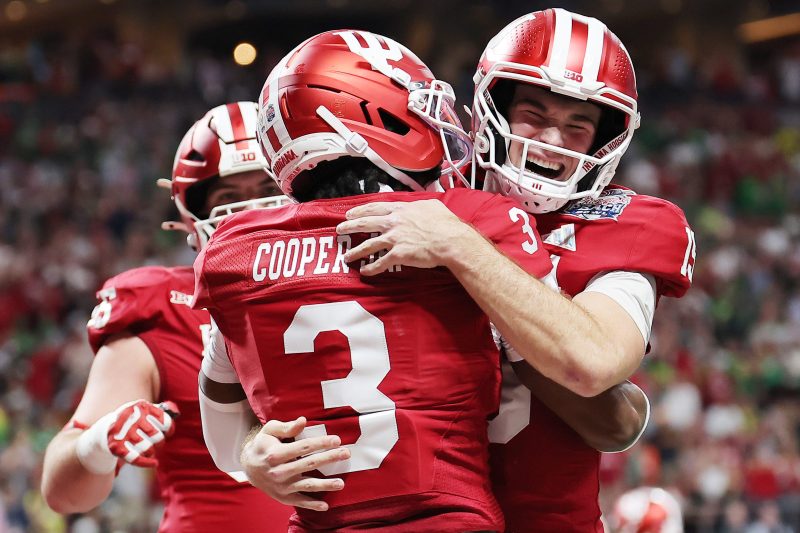
24. Browns (from Jacksonville Jaguars) – WR Omar Cooper Jr., Indiana
Monken’s offense needs more than an overhauled O-line. If QB Shedeur Sanders is to have any shot at developing into a long-term starter here, he not only needs better protection but also more weaponry in the passing game. Mendoza’s leading receiver for the Hoosiers last year, Cooper would provide Sanders with a reliable target out of the slot and theoretically help stabilize this offense.
25. Chicago Bears – S Emmanuel McNeil-Warren, Toledo
Need a Monster of the Midway? How about a 6-foot-4, 200-pound DB with a penchant for big hits and finding the ball? And it certainly seems like the Bears might be in dire need of safety help with All-Pro Kevin Byard and Jaquan Brisker headed for the open market.
As for Moore’s departure, it probably shouldn’t come as a huge surprise − even though he caught two epic touchdown passes to beat the Packers at Soldier Field twice last season. But, overall, Moore wasn’t necessarily a hand-in-glove fit in Ben Johnson’s offense. And given the presence of 2024 first-round WR Rome Odunze plus Luther Burden’s encouraging rookie year last season, Chicago doesn’t need to reach or prioritize backfilling Moore with a premium pick in a deep receiver draft − especially given the holes developing elsewhere on the roster.
26. Buffalo Bills – DE Keldric Faulk, Auburn
The arrival of Moore means GM Brandon Beane doesn’t have to overdraft a wideout here − which is probably what he would have had to do, in a stick-and-pick situation, given none of the best ones were likely to fall this far (despite his Carnell Tate musings at the combine). But the intriguing Faulk, a gem in need of some polish, can fill another area of concern. He should be a three-down player who can kick inside on passing downs. He has a reputation as being an excellent locker-room presence, always a huge plus, and would soften the blow given the likelihood DE Joey Bosa won’t be back in 2026.
27. San Francisco 49ers – OT Caleb Lomu, Utah
GM John Lynch admitted during the combine that he and Trent Williams, 37, are trying to find a financial compromise that keeps the legendary left tackle on the roster in 2026. But even if Williams plays another season, the Niners might be wise to get a replacement in house and – in Lomu’s case – a year to strengthen his 6-foot-6, 313-pound frame might be helpful.
28. Houston Texans – OT Blake Miller, Clemson
The All-ACC right tackle could solidify the protection in front of QB C.J. Stroud by becoming a long-term answer on an O-line that’s been in a state of flux for some time − and is now exporting Howard and Juice Scruggs. Durable, Miller averaged better than 900 snaps during three seasons for the Tigers and can play on the left side in a pinch.
29. Chiefs (from Rams) – OT Max Iheanachor, Arizona State
This had seemed like a perfect landing spot for Alabama QB Ty Simpson, who might have apprenticed for a year or two – or three – under league MVP Matthew Stafford before potentially taking the reins. Now, maybe Simpson could fill in early for Patrick Mahomes … nope. Just nope. Maybe Simpson lands elsewhere in the first round, but it certainly won’t be in K.C.
Yet Mahomes has suffered the highest sack percentage of his nine-year career over the past two seasons and went down a career-worst six times in K.C.’s Super Bowl 59 loss. As he tries to return in time for this year’s regular-season opener, despite rehabbing from a torn ACL suffered last December, upgrading his protection seems imperative – especially given the pending release of RT Jawaan Taylor for performance and compensation reasons, plus the fact that Jaylon Moore didn’t wrest a starting OT job in 2025. Iheanachor isn’t a finished product but is a gifted athlete − one who might only need a bit of time (and ace tutelage from Chiefs offensive line coach Andy Heck) to displace Moore for the primary right tackle job opposite 2025 first-rounder Josh Simmons while vastly improving the odds Mahomes won’t continue running for his life in 2026.
30. Denver Broncos – WR KC Concepcion, Texas A&M
He has average size (6-0, 196) but elite short-area burst and quickness that could make him an ideal complement to Courtland Sutton in Denver’s passing game.
31. New England Patriots – OT Kadyn Proctor, Alabama
The Pats have several needs and options − and don’t be surprised if they’re on the move, up or down − though it sure seems likely they fill their newly formed Stefon Diggs void somehow during free agency. But the obvious issue for the AFC champs during the playoffs was protecting QB Drake Maye, who was sacked 21 times in four postseason games, including six times by the Seahawks in Super Bowl 60. RT Morgan Moses is under contract for two more years but also just turned 35. Proctor can block out the sun yet is an impressively nimble athlete at 6-foot-7 and 352 pounds. He might remind Patriots fans of former Tom Brady bouncer Trent Brown and could also help launch an already strong ground game to a stratospheric level.
32. Seattle Seahawks – RB Jadarian Price, Notre Dame
While they’d certainly like to keep Super Bowl MVP Kenneth Walker III, it also didn’t sound at the combine like the reigning champs were going to pull out all the financial stops in order to keep him at the expense of other priorities − and Walker wasn’t tagged by the Seahawks on Tuesday. But Seattle doesn’t have the luxury of standing pat in the run game, either, given RB2 Zach Charbonnet tore his ACL in January. Price is a slasher who starred in a timeshare with Love at Notre Dame and could nicely fill Walker’s role – maybe Shaheed’s, too, if the Seahawks’ can’t re-sign their pivotal return ace, either.