
So now we’re supposed to be sideways about Charles Bediako, the professional basketball player turned Alabama student-athlete by a Tide fan clothed in a circuit court judge robe.
The horror of it all.
Maybe it’s time to look at it another way: If you’re going to fight with the unreasonable and unpredictable, you better get in the mud with them.
And by them, I mean the NCAA.
Before we get deep into this latest dissertation on the dysfunctional, make-it-up-as-you-go organization, let’s not forget the most decisive and destructive legal case against the NCAA was also won with the help of judge shopping.
In 2023, after the NCAA gave players one free transfer as part of their we-know-we’re-screwed legal strategy, a group of West Virginia players decided they wanted more — and shopped their case to the Northern District of West Virginia.
That case was heard by U.S. District Judge John Preston Bailey, who just so happened to receive his Juris Doctor from WVU. Who just so happened to have been born in Wheeling, W.V., and had a private practice in Wheeling from 1978-2007 before being nominated to the district court.
He struck down the NCAA’s year in residence transfer rule, and paved the way for the annual free player movement we have today. The most devastating ruling against the NCAA in the history of college sports.
Every player procurement functionality problem facing the NCAA today can be traced to free player movement.
Now let’s move forward, beyond Bediako and the West Virginia ruling and into the sport that rules the roost. The sport so affected and impacted by NIL and free player movement, no one — players, coaches, agents/representatives, the NCAA — knows which rules apply to which circumstances and players.
The NCAA has two answers in football eligibility cases beyond the five-year clock: no, and make it up on the fly.
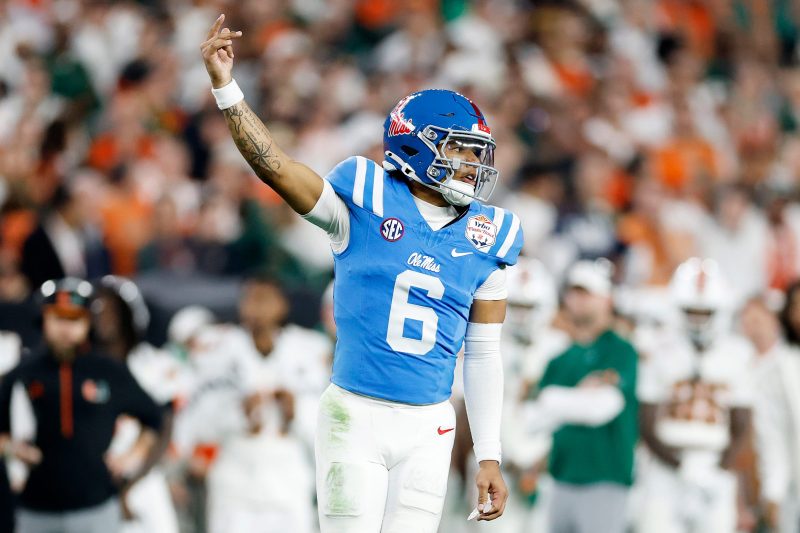
It is here where we introduce Ole Miss star quarterback Trinidad Chambliss, whose attorneys — I know this is going to shock you — have scheduled a hearing next month in the Calhoun (Miss.) County Courthouse. The judge overseeing the case is Robert Whitwell, a Senatobia, Miss., native, an Ole Miss Law graduate and a former quarterback at Northwest Mississippi Community College.
You can see where this is headed.
But why wouldn’t attorneys for Chambliss and Bediako and any other player searching for eligibility, judge shop? Why would they leave it up to the fanciful whims of the NCAA, which not so long ago allowed North Carolina — in the middle of a decade of academic scandal — to successfully use the argument that fake classes allowing athletes to stay eligible were also available to regular students. Therefore, the classes weren’t actually fake.
I swear I’m not making that up.
Or the same NCAA that once placed Boise State on probation because potential recruits were sleeping on the couches and floors of current players while participating in legal summer workouts.
I’m not making that up, either.
Chambliss and Ole Miss tried the correct course of action, pulling together a detailed appeal for Chambliss during the 2025 season in an effort to get ahead of any potential snags for 2026. The NCAA said Ole Miss didn’t provide sufficient evidence to prove a medical condition prevented Chambliss from playing in 2022, and denied the appeal.
So Chambliss’ attorney — noted NCAA pain-in-the-neck Tom Mars — filed a lawsuit providing proof from Ferris State’s Director for Sports Medicine, its head football coach, and from a licensed otolaryngologist. Chambliss, the group said, had complications from mononucleosis, COVID-19, chronic tonsillitis and other respiratory illnesses in 2022 that prevented him from participating.
It wasn’t long ago the NCAA decided to give an extra season of eligibility to all student-athletes impacted by COVID-19 during the pandemic season of 2020. But in this case, with this specific player, the request was denied.
Which makes about as much sense as fake classes really weren’t fake if all students had access.
Are you really surprised players and their representatives are judge shopping to get level playing fields against a rudderless organization comprised of 300-plus presidents and chancellors making random decisions through committees, subcommittees and appeal committees?
An organization that says no until it’s forced to say yes by a court system it has no control over. An organization that lost control of Power conference football, so it dreamed up something called the College Sports Commission — a do-nothing body that can’t get the 65 Power teams to agree to not cheat.
To say nothing of the CSC getting control of rampant academic abuse. I ask you, when was the last time a player was academically ineligible?
Or are we all supposed to believe that credit hours from each institution ― wildly different and unique in course instruction ― are accepted by every other institution?
If they transfer for athletes, they should be transfer-eligible for all students. Right, North Carolina?
And yet here we are, obsessed with judge shopping for a former G League player.