
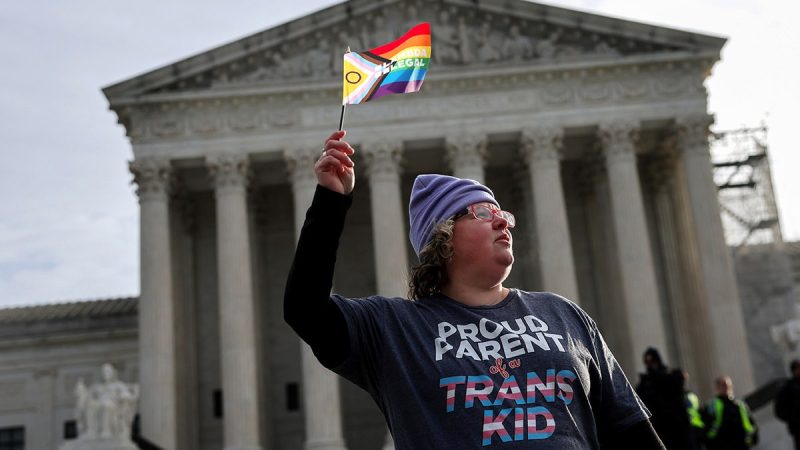
A top House lawmaker and former softball coach is arguing that allowing transgender women who were born male to play on female sports teams is ‘the biggest form of bullying.’
House GOP Conference Chairwoman Lisa McClain, R-Mich., is expected to appear at a rally in support of banning biological males from playing on school sports teams for girls and women on Tuesday.
It’s the same day the Supreme Court is expected to hear oral arguments on the legality of such bans in two states, cases that could have ramifications for school sports across the country.
The cases, challenging state laws by GOP-led governments in Idaho and West Virginia, will decide whether discrimination based on gender identity violates federal civil rights laws.
But McClain, who spent almost a decade coaching girls’ softball, said it was not an issue of left or right.
‘This isn’t a conservative-progressive [issue]. You can’t put a label on it. The label is female versus male. Those are the labels you should be talking about,’ McClain said. ‘It’s, does this Supreme Court recognize females?’
As a business owner before Congress, McClain said she also coached her daughter and other girls, starting when her child was 9 through high school.
She said there would have been ‘intense conversations’ if her team had to face another with a transgender player.
‘I’ll just share with you, it wouldn’t happen,’ she said of the hypothetical face-off.
‘You want to talk about fairness and all that stuff. I’ll compete with any female athlete, any female athlete. Don’t have a guy pretending to be a woman come in, undress in the locker room in front of my daughter or any of the girls that are on my team. Are you kidding me?’
LGBTQ advocates have said a Supreme Court ruling in favor of the state governments would be a step back for transgender rights.
But people who support the bans, like McClain, have said it’s a fight for women’s rights.
‘Where all these feminists that fought so hard for women, for women’s rights, for Title IX?’ she asked.
‘This is an attack on women. So you can stand with the transgenders, that’s fine. You can be who you want to be, be transgender, if that’s who you want to be. But when who you are decides to infringe on my rights, that’s when I have a problem.’